
 Portuguese
  English
  Spanish
  Russian
  French
  Japanese
  Indonesian
  German
  Italian



If your beauty brand has a strong environmental focus, or you are developing products for the dermocosmetic market, a degradable PLA makeup brush handle is a material worth considering.
PLA, or polylactic acid, is a plant-based polymer made from renewable resources such as corn and cassava. Unlike conventional petroleum-based plastics, PLA offers a different material pathway for product development and can provide biodegradable properties under suitable conditions.
But sustainability alone does not make a good makeup brush handle.
A handle still needs to be practical. It needs to withstand daily use, feel comfortable in the hand, and maintain its structure throughout the product’s useful life.
This creates an important question for beauty brands:
Can a material be more environmentally responsible without giving up the durability that a makeup brush needs?
The answer depends on how the material is designed and processed.
This is where PLA-based composite materials become interesting. Rather than treating sustainability and performance as two opposite choices, material development can explore how different components work together to create a better balance.
What Is a Degradable PLA Makeup Brush Handle?
PLA stands for polylactic acid, a biodegradable polymer that can be produced from renewable plant-based resources.
For beauty tools, PLA offers an alternative approach to conventional plastic handle materials. Its plant-based origin makes it attractive for brands that want to explore more sustainable product concepts.
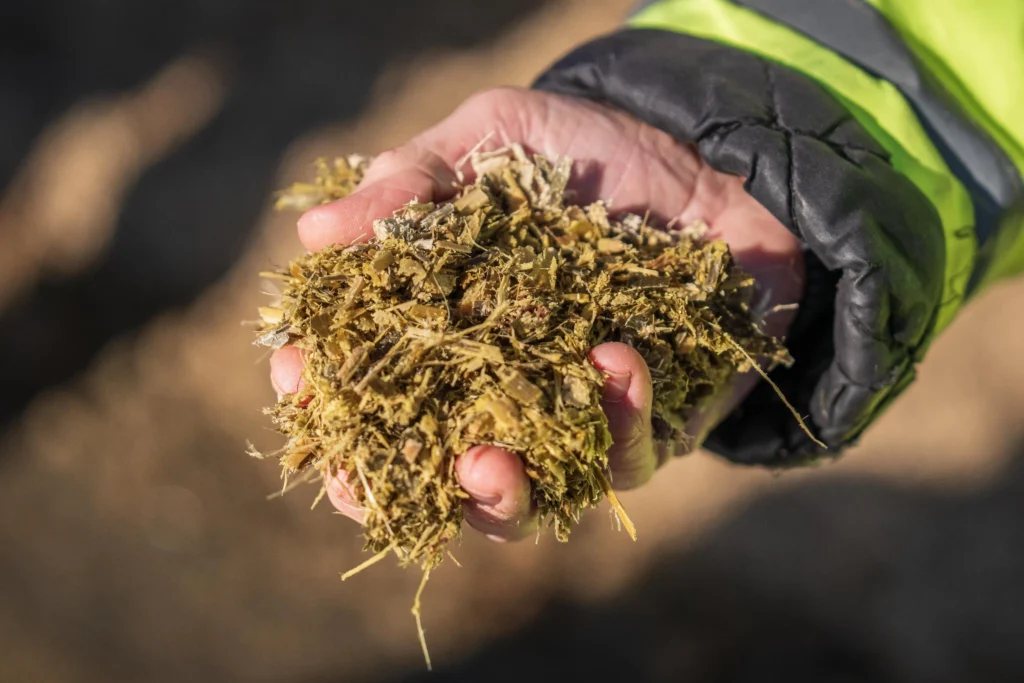
Corn and cassava are two examples of agricultural resources that can provide starch for PLA production. This gives PLA an important characteristic: its raw material pathway can be connected to renewable resources rather than relying solely on fossil-based feedstocks.
However, it is important to look at PLA objectively.
“Plant-based” does not automatically mean that every PLA product will quickly disappear in the natural environment. Biodegradation depends on the material formulation and environmental conditions. Therefore, brands should consider the complete product and its intended end-of-life pathway when making sustainability claims.
For a makeup brush manufacturer, this distinction matters.
The goal is not simply to use a material with a green-sounding name. The goal is to develop a product where the material’s environmental advantages and practical requirements can work together.
Why Eco-Conscious Beauty Brands Are Considering PLA Handles
For environmentally conscious beauty brands, the material used in a product can become part of the brand’s identity.
Consumers are increasingly interested in the story behind beauty products. They may look beyond the formula and ask where materials come from, how products are manufactured, and whether brands are making more responsible choices.
A degradable PLA makeup brush handle can support this type of product strategy.
For sustainable beauty brands, it can reinforce a message around renewable materials and responsible design.
For dermocosmetic brands, it can complement a product philosophy that emphasizes thoughtful materials and a cleaner overall consumer experience.
For brands developing new product lines, it can also provide a way to introduce sustainability at the product level rather than relying only on external packaging.
At the same time, brands should avoid treating PLA as a universal answer.
Different products have different requirements. Some may prioritize durability and cost efficiency, while others may place greater emphasis on biodegradability and material storytelling.
The right question is therefore not:
“Is PLA better than traditional plastic?”
A more useful question is:
“Is PLA the right material for this particular product and brand strategy?”
Can a PLA Makeup Brush Handle Provide Enough Durability?
This is one of the most important questions when developing a sustainable makeup brush.
A brush handle is held, squeezed, cleaned, stored, transported, and used repeatedly. If a sustainable material cannot withstand normal product use, its environmental advantages become much less meaningful.
This is why material research often focuses on composites rather than relying on one material alone.
A useful reference is the research by Shanshan Lyu, Jun Cao, Haiyan Tan, Jiyou Gu, and Yanhua Zhang, published in Acta Materiae Compositae Sinica in 2015. The researchers studied wood flour-starch/PLA composites and examined how different wood flour contents affected their interfacial compatibility, thermal behavior, mechanical properties, rheological properties, and water absorption.
Their results offer an important lesson for product development:
Adding a natural material to PLA is not simply a matter of adding more and expecting better performance.
In their experimental system, the tensile and bending strengths increased at first as wood flour content increased, then decreased. At 18 wt% wood flour, the composite reached its highest reported tensile strength of 40.65 MPa and bending strength of 60.91 MPa. At the same time, increasing wood flour content reduced elongation at break and increased water absorption.
This is a good example of why composite material development requires balance.
How Plant-Based Composite Materials Can Balance Performance
The research above does not directly test SY Beauty’s makeup brush handle formulation, so its results should not be treated as a direct performance claim for this product.
What it does provide is a useful material-development principle.
A composite can be designed by combining different materials to balance their individual characteristics.
PLA provides a biodegradable polymer matrix. Natural materials such as wood flour or starch can introduce additional properties and change the structure of the composite.
But the relationship is not always linear.
More natural filler does not automatically mean a stronger or better material. The researchers found that increasing wood flour content eventually reduced tensile and bending strength after reaching an optimum under their tested conditions. They also observed lower elongation and higher water absorption as wood flour content increased.
For a makeup brush manufacturer, this kind of research is valuable because a handle needs a practical balance between properties.
It needs enough rigidity to maintain its shape.
It needs sufficient strength for normal handling.
It needs to be comfortable for the user.
And if sustainability is part of the product concept, the material also needs to support the intended environmental goals.
That is why material development is not simply about finding the “greenest” ingredient. It is about finding a workable combination.
What Makes a Degradable PLA Handle Different From Traditional Plastic Handles?
Traditional plastic handles remain widely used for good reasons. They offer established manufacturing processes, consistent performance, and a broad range of design options.
PLA does not need to be positioned as a complete replacement for every conventional plastic.
Instead, it gives beauty brands another choice.
A traditional plastic handle may be suitable when production stability, cost, and conventional processing are the primary priorities.
A degradable PLA makeup brush handle may be more attractive when a brand wants to emphasize plant-based materials, biodegradable design, and sustainability.
The difference is therefore less about declaring one material the winner and more about matching material characteristics with product objectives.
For beauty brands, having more material choices can make product development more flexible.
Who Should Consider Degradable PLA Makeup Brush Handles?
Sustainable Beauty Brands
Brands with a strong environmental identity can use PLA as part of a broader sustainable product strategy.
It can work particularly well when the handle is combined with other responsible material choices throughout the product.
Dermocosmetic and Skincare-Oriented Brands
Consumers of skincare-focused products often pay close attention to the materials and philosophy behind a product.
For these brands, a PLA handle can complement a product concept built around thoughtful and responsible design.
Brands Developing Future-Oriented Beauty Tools
Sustainability and material innovation are becoming increasingly important in beauty product development.
For brands looking to move beyond conventional product design, PLA provides another material direction worth exploring.
Why Material Innovation Matters for Makeup Brush Manufacturers
A professional fabricante de pincéis de maquiagem should do more than reproduce existing products.
Material innovation begins with questions:
What does the consumer need?
What does the product need to withstand?
What material can create the right balance?
And how can that material be produced consistently at scale?
These questions are especially important when developing sustainable beauty tools.
The purpose of innovation is not to make a product sound more advanced. It is to create a material solution that has a practical reason to exist.
For SY Beauty, the development of sustainable handles is part of a wider exploration of how material technology can improve beauty tools.
O degradable PLA makeup brush handle is one example of this approach: using plant-based material concepts while considering the performance requirements of a product that consumers use every day.

Explore More Sustainable Handle Materials With SY Beauty
Degradable PLA Handle is one of several material options available for customized makeup brush development.
Different brands may have different priorities.
A sustainability-focused brand may prefer biodegradable or plant-based materials. A brand looking for recycled materials may consider PCR. Another brand may want a more distinctive natural texture or material story.
SY Beauty also offers options such as PCR Handle, Tea Fiber Handle, Coffee Grounds Handle, Wheat Straw Handle, and Sawdust Wood Handle.
You can explore more customized handle materials on the [Custom Makeup Brush] page and compare different possibilities for your next product concept.
If you already have an idea for a sustainable beauty tool, the right material combination can be developed around your brand positioning, product requirements, and target consumer.
Sustainability Needs Both Responsibility and Performance
A sustainable makeup brush should not be defined by one word on a material specification sheet.
It should be considered from several angles:
Where does the material come from?
How does the product perform during its useful life?
What happens when the product reaches the end of its life?
Does the material genuinely support the brand’s environmental goals?
These questions lead to a more balanced way of thinking about sustainable beauty tools.
A degradable PLA makeup brush handle is not valuable simply because it is plant-based. Its value comes from combining a different material pathway with the practical requirements of a real beauty product.
For eco-conscious beauty brands and dermocosmetic companies, that balance can open up new possibilities.
The future of sustainable beauty is unlikely to come from one material alone. It will come from better questions, better material combinations, and better product development.
And sometimes, a more responsible makeup brush begins with something as simple as choosing a different material for its handle.
Read more
- Degradable PLA Makeup Brush Handle: A Sustainable Material Choice for Beauty Brands
- Tea Fiber Innovation Handle: Natural Materials in Makeup Brush Design
- PCR Makeup Brush Handles: How Recycled Materials Are Shaping Sustainable Beauty Tools
- A Guide About Choosing Makeup Brush Bristle Materials for Beauty Brands
- 10 Questions to Ask Before customizing makeup brush