
 English
  Spanish
  Portuguese
  Russian
  French
  Japanese
  Indonesian
  German
  Italian



The world is advancing, and new advanced technologies are constantly emerging in the makeup brush market. How to improve makeup brush pickup will remain a persistent issue. It can bring significant benefits to consumers and also build confidence for the brand. For both makeup users and professional artists, one of the most noticeable differences between brushes is how efficiently they pick up powder products. Some brushes require repeated dipping, while others load pigment quickly and evenly in a single touch.
This difference is not random. It reflects a deeper structural property known as high powder pickup performance—the ability of a brush to efficiently capture and hold powder through its fiber design.
Instead of focusing only on softness or density, modern brush development is increasingly centered on how effectively a brush interacts with powder at the structural level.
Why High Powder Pickup Performance Matters
In real-world use, powder pickup efficiency directly affects the makeup experience.
When a brush has low pickup performance, users often face:
- repeated dipping into powder products
- uneven pigment loading
- reduced efficiency in application
- inconsistent makeup results
On the other hand, brushes with strong high powder pickup performance can:
- load more product in a single dip
- reduce application time
- improve consistency of makeup results
- enhance overall user satisfaction
This makes powder pickup not just a performance detail, but a core part of product quality perception.

Factor One: Increasing Fiber Contact Points
The first and most fundamental way to improve high powder pickup performance is by increasing fiber contact points.
Traditional brush fibers typically feature a single tip structure. While this design is stable and widely used, it limits how many points of contact can interact with powder particles.
Each fiber essentially acts as a single “entry point” for powder pickup. This means that the total interaction surface is relatively restricted.
By increasing the number of effective contact points, the brush is able to:
- create more opportunities for powder adhesion
- improve initial capture efficiency
- enhance overall powder engagement across the brush surface
In simple terms:
More Contact Points = More Chances to Pickup Powder
This makes contact point design a foundational factor in achieving high powder pickup performance.
Factor Two: Increasing Effective Fiber Density
The second key factor is fiber density—not just in terms of quantity, but in terms of effective working fibers.
Many brushes appear dense visually, but not all fibers contribute equally to powder pickup. What matters is how many fibers actively participate in powder engagement.
Higher effective density leads to:
- stronger powder loading capacity
- more concentrated pigment collection
- improved single-dip efficiency
- more stable application results
However, density must be carefully balanced. If fibers are too tightly packed, powder may become trapped and difficult to release. If density is too low, pickup efficiency drops significantly.
Therefore, the goal is not simply “more fibers”, but optimized functional density for high powder pickup performance.
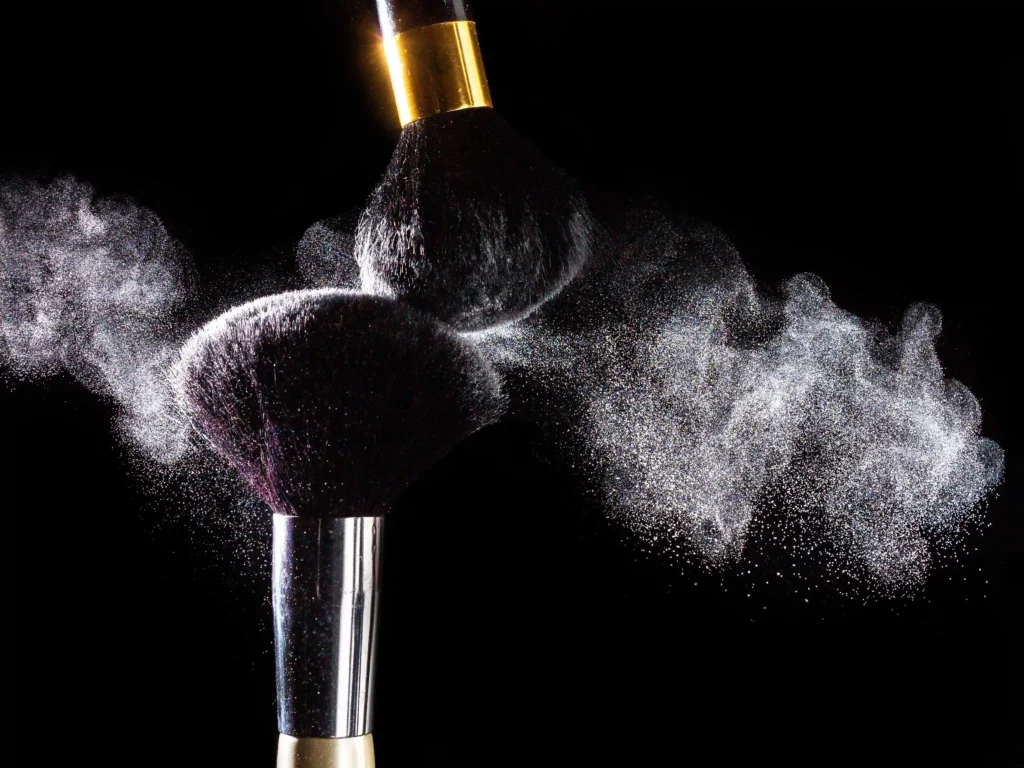
How Contact Points and Density Work Together
While contact points and fiber density can be discussed separately, their real impact appears when they work together.
Contact points determine how many interactions occur between brush and powder. Density determines how much powder can be carried and stabilized within the brush structure.
When combined effectively, they create a system where:
- powder is captured more easily
- more powder is retained during loading
- application becomes smoother and more controlled
This interaction forms the foundation of modern improve makeup brush pickup design in makeup brushes.
Instead of relying on surface-level softness or shape, performance is now determined by structural efficiency.
Rethinking Powder Pickup as a Structural Feature
Traditionally, makeup brush development has focused on tactile qualities such as softness, flexibility, and blending ability. While these characteristics remain important, they no longer fully define performance.
High powder pickup performance represents a shift in thinking—from surface feel to internal structure.
In this new approach, powder pickup is not treated as a byproduct of material choice, but as a result of intentional structural design, including:
- fiber interaction geometry
- effective contact distribution
- optimized density balance
This structural perspective allows developers to design brushes with predictable and consistent performance outcomes.

Practical Implications for Brush Development
Understanding improving makeup brush pickup has several practical benefits for product development:
- More efficient use of powder products
- Reduced need for repeated product loading
- More consistent application results
- Improved performance across different brush types
For brands and manufacturers, this also creates opportunities to differentiate products based on measurable functional advantages rather than purely aesthetic features.
In a competitive beauty tools market, these subtle performance differences can significantly influence user preference and brand positioning.
High Powder Pickup Performance Is a Structural Outcome
Ultimately, high powder pickup performance is not the result of a single material or a single feature. It is the combined outcome of multiple structural decisions.
The most important factors are:
- the number of fiber contact points
- the effective density of working fibers
Together, these elements determine how efficiently a brush can interact with powder products.
As the beauty tools industry continues to evolve, performance is increasingly defined not by how a brush feels, but by how effectively its structure supports real-world use.
In this sense, high powder pickup performance is not just a feature—it is a design philosophy.